
Retirement income planning for older adults involves understanding the different mechanisms that can deliver money after regular employment ends. This concept covers publicly administered pensions, employer-sponsored plans, private savings and income-conversion products that provide periodic payments. The focus is on how these sources generate ongoing cash flow, how they interact, and how choices about timing and payout style can affect the amount and duration of income available during retirement.
Key aspects include eligibility rules, the method used to calculate benefits, payment frequency and flexibility, and the potential tax implications that apply to each source. Planning typically considers both predictable, contractually defined payments and more flexible arrangements where account balances are drawn down over time. The goal of examining these elements is to clarify trade-offs between steady income, liquidity, and potential longevity exposure.

Comparing these sources involves examining predictability, flexibility, and exposure to market and longevity risk. Public pensions and defined benefit occupational plans typically offer predictable periodic payments but may have eligibility or indexation constraints. Defined contribution accounts and personal savings provide flexibility in timing and amounts withdrawn yet are subject to market fluctuations and require planning to avoid exhausting resources prematurely. Annuity-type conversions can trade liquidity for longevity protection, which some people may value depending on other income sources.
Eligibility and payout timing often influence retirement strategy. Age-based eligibility, vesting schedules, and early-retirement reductions can materially change expected income flows. For account-based plans, the timing of withdrawals may interact with tax rules or required minimum distributions in some jurisdictions. Individuals may therefore weigh the immediate income benefit of earlier payments against the potential for larger later payments or different survivor provisions if deferral is permitted.
Benefit calculations typically rely on a formula for DB plans (for example, years of service times a multiplier times final salary) or on the accumulated balance for DC plans. For annuities, pricing reflects assumptions about longevity, interest rates, and administrative costs. Because underlying assumptions and methods vary, it can be useful to compare estimated periodic payouts under different conversion choices without assuming one option is universally preferable.
Tax treatment and interaction among income sources can affect net retirement income. Some pensions may be taxable, some partially exempt, and some withdrawals from savings may be taxed differently depending on account type and local rules. These distinctions often influence when income is taken and how different sources are sequenced. Considering potential taxation effects may help in understanding net cash flow rather than gross payouts alone.
In summary, older-adult income choices typically involve trade-offs among predictability, flexibility, and longevity protection. Reviewing public pensions, occupational plans, private accounts, and income-conversion products in the context of eligibility, payout mechanics, and tax treatment can clarify which combinations may meet different needs. The next sections examine practical components and considerations in more detail.

Public pensions often form a baseline for retirement income in many countries and may supply a meaningful portion of routine spending needs. These schemes typically base payments on earnings history, contributions, or residency periods. Employer-sponsored plans may operate alongside public systems and vary materially in structure: defined benefit plans calculate an income stream through a formula, while defined contribution plans accumulate assets for later withdrawal. Personal savings and investments act as a supplement and can be drawn down or converted into income products. Understanding the typical role of each source helps in constructing a diversified approach to income flows.
Defined benefit arrangements may include survivor options and cost-of-living adjustments, which influence long-term income stability. Defined contribution balances are sensitive to investment performance and withdrawal choices; commonly referenced safe-withdrawal heuristics may be discussed but should be evaluated against individual circumstances. Personal savings often supply discretionary spending and emergency liquidity, while annuity products may be used to convert a portion of savings into a more predictable payout. Each source may address different objectives such as baseline needs, discretionary spending, and longevity protection.
From a planning perspective, the interaction among sources is relevant: public pensions may replace a fixed share of pre-retirement income for some workers, while employer and personal resources fill remaining gaps. Typical replacement rates vary by system and earnings level, so combining sources to reach a desired replacement range often requires estimating probable payouts under realistic assumptions. Simulations and scenario testing are commonly used to compare outcomes under different economic conditions and lifespans.
Considerations for seniors often include sequencing—deciding which income source to tap first—and whether to retain liquidity for unexpected costs. Market volatility can affect account-based sources, so some individuals may prefer a mix that includes steady pension streams plus flexible savings. These points are offered as considerations to explore rather than prescriptive steps, and they may guide further analysis in subsequent sections.
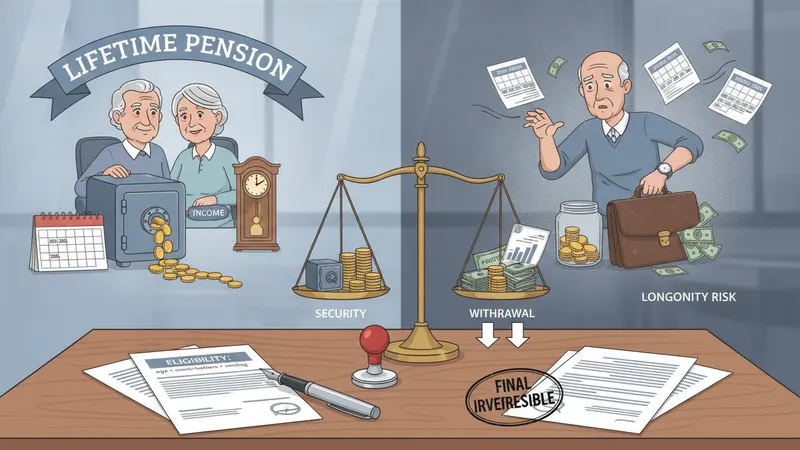
Eligibility criteria for pensions typically include age requirements, contribution history, and minimum service periods. Some systems permit reduced benefits for early claiming, while others allow delayed retirement credits that increase later payouts. Vesting rules in occupational plans determine whether a worker retains rights to employer-provided benefits after changing jobs. For account-based plans, eligibility may not be restrictive, but access rules and tax treatments often depend on age or other qualifying events. Understanding these conditions is important when assessing expected income timing and amounts.
Payout structures can be periodic lifetime payments, joint-and-survivor options, lump-sum distributions, or flexible withdrawals from accounts. Lifetime pension options provide income continuity but may reduce access to principal. Lump-sum withdrawals offer liquidity and control but require active management to avoid longevity shortfalls. Joint options may reduce the initial payment to provide survivor protection. These structural choices typically reflect trade-offs between income security and flexibility, and they are often irreversible once selected.
Communication clarity is a practical consideration: plan documentation should specify how benefits are calculated, whether payments are indexed for inflation, and the mechanics of survivor benefits. Where formulas apply, they may reference final or career-average earnings, multipliers, and service credits—each altering the benefit profile. When considering conversion of account balances into income, transparent information on fees, assumptions about life expectancy, and surrender provisions can materially affect the net income realized over time.
As an insider consideration, it can be helpful to request personalized benefit estimates and scenario tables from plan administrators or insurers, showing alternative claiming ages and payout forms. These estimates often illustrate how small timing differences can change lifetime income amounts. This information supports comparison across sources and informs choices about sequencing, deferral, and partial conversions.

Tax rules often shape net retirement income more than gross payouts, since different sources may be taxed in distinct ways. Some contributions are pre-tax and withdrawals are taxable, while others are made with after-tax funds and offer tax-free distributions later. The timing of withdrawals can affect marginal tax rates in a given year and influence social benefits or means-tested support in some systems. Understanding the typical tax profile of each income source helps clarify net cash flow after statutory deductions.
Benefit calculations for defined benefit plans usually use explicit formulas involving service years and salary measures; for account-based plans, the accumulated balance and assumed conversion factors determine periodic payout amounts. Annuity pricing reflects life expectancy assumptions, prevailing interest rates, and product costs, which means income from conversion of a balance may rise or fall with market conditions. Comparing estimates on an after-tax, after-cost basis provides a clearer view of practical income potential.
Commonly used analytical techniques include projecting several withdrawal sequences, modeling tax effects under different income scenarios, and running sensitivity checks for interest-rate and longevity changes. These methods may reveal that small adjustments to claiming age or withdrawal sequencing can materially alter net outcomes. While modeling cannot ensure a specific future, it can help identify scenarios that may warrant further attention or conservative planning buffers.
An informational tip is to collect documentation showing how each plan treats taxes, indexation, and survivor provisions, and to use these inputs consistently in any comparison model. Where professional projections are sought, verify assumptions about longevity and discount rates, and treat differing assumptions as part of a range rather than a single forecast.

Longevity risk, inflation, healthcare costs, and unexpected expenses are common factors affecting long-term income stability. Longevity risk refers to the chance that a person will outlive accumulated resources; products that convert capital into lifetime streams address this partially. Inflation erodes purchasing power over time, so indexation or inflation-linked payout options may be relevant. Healthcare and long-term care expenses can be significant and are often unpredictable, which underscores the value of maintaining some liquid reserves in addition to income streams.
Market risk affects account-based resources; sequence-of-returns risk is particularly relevant when withdrawals begin near a market downturn. Diversification across asset types and timing considerations for converting assets into income can help manage these exposures, though diversification does not eliminate risk. Balance between guaranteed income and flexible savings tends to be a central planning trade-off, and the appropriate balance varies with personal priorities, health expectations, and other income sources.
Behavioral and administrative factors also matter: opting for complex payout structures without clear understanding can lead to unintended gaps or excesses. Survivor and beneficiary provisions should be checked for their implications on household income. Periodic review of income needs and adjustments to withdrawal rates can respond to changing circumstances, but such adjustments may have long-term effects on sustainability and should be evaluated carefully.
As a practical consideration, scenario planning that includes conservative assumptions for lifespan and returns can reveal potential shortfalls early. Maintaining documentation of plan features, projected payouts, and tax treatments supports informed decision-making. These considerations are intended to guide analysis rather than prescribe specific actions, and they may inform how different income sources are combined to support long-term financial stability.